
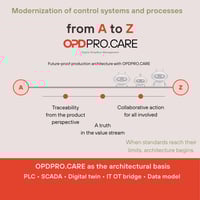
The solution connects people, machines, products and systems through an open and future ready...
OPDPROCARE Version 4.0: Greater transparency, traceability, and efficiency in the process industry
OPDPRO.CARE Version 4.0: More transparency, traceability and efficiency in the process industry
22:36
OPDPROCARE Version 4.0
The digital platform for greater transparency, controllability and traceability in the process industry
OPDPROCARE Version 4.0 is an end-to-end digital platform for companies in the process industry that not only want to document their processes, but also actively control, evaluate and improve them. The solution combines product definition, raw material management, intermediate products, production, packaging, finished goods, storage locations, assets, evaluations, interfaces and AI-supported analyses in a common system logic.
This creates a uniform digital view of the entire value stream. Processes are modeled in a comprehensible way, inventories are managed realistically, production data is evaluated in a structured manner and quality and material relationships are made completely traceable.
OPDPROCARE Version 4.0 helps companies to master complexity, create standards, reduce maintenance effort and base decisions on reliable operational data. This is precisely where the decisive added value for the process industry lies.
What distinguishes OPDPROCARE Version 4.0
OPDPROCARE Version 4.0 maps real processes as they actually take place in practice. The platform does not think in terms of isolated individual functions, but in terms of interrelated processes along the value stream.
Products are built up from reusable recipes and processes. Intermediate products are understood as independent process stages and managed with stocks. Packaging and finished goods are neatly integrated into the production logic. Storage locations are not only managed, but used specifically as part of the process and logistics structure. New asset types such as pelletizers, baggers or big bag stations expand the operational mapping of the value stream. At the same time, graphical logs, asset-related evaluations, KPI views and an AI assistant ensure that data is turned into real actionability.
This turns a classic software application into an operational and strategic platform for the digital management of the process industry.
The product description in detail
1. processes and product definition
In the area of processes, OPDPROCARE Version 4.0 creates the basis for clear, reusable and comprehensible modeling of products and processes.
Products can be defined on the basis of standardized recipes and processes. This means that recurring content is not maintained multiple times, but reused intelligently. This reduces complexity and creates order in the product and process structure. Recipe groups also help to neatly organize variants, relationships and standards.
A particular added value lies in the graphical representation of recipe components. Raw materials, intermediate products and packaging are not only managed in text form, but are also depicted in a visually comprehensible way. This makes it easier to understand complex recipes and supports departments such as production, process engineering, quality and digitalization in equal measure.
Intermediate products can be created as independent modules and reused later in other recipes. This makes multi-stage process logic digitally tangible and manageable.
Advantages in this area
Greater reusability
Less maintenance effort
Better standardization
Clearer structure in variant management
Better understanding of complex process chains
Stronger basis for optimization and scaling
2. raw materials, intermediate products and material logic
In the area of raw materials, OPDPROCARE Version 4.0 significantly expands the view of materials. Raw materials are not only managed, but also viewed in their actual transformations, interrelationships and uses along the value stream.
Raw material transformations show how input material develops into different qualities, forms or intermediate stages. Intermediate products are managed with their own stocks, which are automatically created from actual production orders. This brings the inventory logic much closer to the actual production reality than purely manual or booking-driven approaches.
Intermediate products can be used directly as part of recipes. This means that a multi-stage, modular production structure can be clearly mapped in the system. This is supplemented by the definition of packaging as independent objects and an ingredient report with conversion and export functions.
Advantages in this area
Transparent material flows
Better scheduling
More reliable requirements planning
Greater traceability of raw materials and intermediate stages
Realistic stocks
Convenient evaluation of consumption and ingredients
Better basis for purchasing, production and quality
3. delivery and packaging
Version 4.0 systematically integrates packaging into the material and production logic. Packaging can be defined, delivered, managed and documented on an order-related basis.
In the delivery area, there are separate processes for the goods receipt of packaging. This is particularly relevant for companies that need to have packaging material under control not only organizationally but also operationally. The structured management of packaging creates greater transparency regarding availability, use and consumption.
Packaging also becomes part of the product definition and production logging. This creates a continuous link between product, order, batch, packaging and storage location.
Advantages in this area
Clean management of packaging material
Greater transparency regarding packaging requirements
Better traceability of packaging usage
Fewer manual gaps in material management
Better basis for cost analysis and planning
4. production and order management
The production area is one of the strongest enhancements of OPDPROCARE Version 4.0. Here it becomes clear how consistently the platform is geared towards real practice in the process industry.
Production data is continuously recorded on an order-related basis and displayed graphically. This makes time sequences, quantities, statuses and anomalies visible. In addition, logs can also be evaluated in tabular form on an asset-related basis. This creates transparency both from the perspective of the specific order and from the perspective of individual system parts.
Manual weighing orders can be run independently. This provides significantly better support for manual or partially manual processes on a day-to-day basis. Batch labels are printed automatically and can be recreated manually if required. Conspicuous batches are highlighted in color and provided with notifications. This allows deviations to be identified more quickly and processed in a more targeted manner.
Order management has also been expanded to include important station types. These include bagging stations, big bag stations and pelletizers. This means that OPDPRO.CARE Version 4.0 maps critical points in the real production environment much more precisely.
Another important point is the mandatory destination storage location specification for each order. This ensures that each production result is directly assigned to a specific storage location.
Advantages in this area
Better control of orders
More transparency in ongoing operations
Faster detection of deviations
Greater practical relevance for manual processes
Fewer errors with labels and assignments
Clear link between production and warehouse
Better evaluability at order and item level
More targeted bottleneck and root cause analysis
5. value stream, assets and warehouse logic
In the value stream, OPDPROCARE Version 4.0 significantly expands the view of material flow, storage locations and production assets.
Storage locations for finished goods can be clearly labeled. This creates structure in the warehouse and makes it easier to separate raw materials, intermediate products and finished goods. At the same time, new asset types such as pelletizers, baggers and big bag stations are integrated into the value stream in a visible and evaluable way.
This allows companies to digitally map their real plant structure much more accurately. Asset-related evaluations make performance, usage and anomalies per asset visible. In addition, KPI views and basic dashboards are available in the detailed view of scales.
This combination of structural view, performance data and process reference makes the value stream not only visible, but also operationally controllable.
Advantages in this area
Better transparency in the material flow
Clear warehouse structure
Greater visibility of system performance
Targeted bottleneck detection
Better prioritization of improvements
More clarity about utilization and capacity utilization
More informed decisions for optimization and investment
6. finished goods
Version 4.0 significantly enhances the inventory management of finished goods as a separate area.
Finished goods stocks are created on the basis of actual production orders. This reduces manual bookings and increases proximity to actual production. In conjunction with storage locations, packaging and batches, a reliable and traceable view of finished products is created.
This is particularly important in the process industry because availability, traceability and warehouse transparency are closely linked.
Advantages in this area
Realistic stocks of finished goods
Less manual maintenance
More transparency about available goods
Better traceability
Stronger connection between production, warehouse and shipping
7 AI Assistant
The AI Assistant adds an additional level of data analysis and decision support to OPDPROCARE Version 4.0.
Instead of just displaying data, the assistant helps to identify patterns, anomalies and correlations more quickly. This can relate to batch sequences, consumption patterns, performance differences, stock trends or other operational key figures. In this way, AI not only supports analysis, but also the understanding of complex relationships within the process industry.
Advantages in this area
Faster pattern recognition
Earlier indications of problems
Better evaluation of complex data situations
More support for decisions
Greater benefit from existing data
8 APIs and integration capability
The existing interfaces have been adapted to the new data structures in version 4.0. This means that new objects such as intermediate products, finished goods, extended assets or log data can also be taken into account in integrations.
This is a crucial point for companies that want to further develop their system landscape. OPDPRO.CARE Version 4.0 thus creates a strong basis for connections to ERP systems, MES structures, BI applications or other digital solutions in IT and OT environments.
Advantages in this area
Strong integration basis
Clean transfer of new data structures
Better connectivity to existing systems
Future-proof architecture for digitalization projects
9 Comprehensive optimizations
In addition to the major functional enhancements, OPDPROCARE version 4.0 also brings noticeable improvements in everyday use.
The asset search has been optimized and the relevance of the search results improved. The raw material number is also displayed in the asset tile view. The general data search across all areas has also been expanded so that users can find information more quickly and recognize correlations more easily.
In day-to-day operations in particular, this often makes the difference between a system that is just there and a platform that is actually used.
Advantages in this area
Less search effort
Faster access to relevant information
More user-friendliness
Greater acceptance in everyday life
Fewer queries and misunderstandings
All the key benefits of OPDPROCARE Version 4.0 at a glance
OPDPROCARE Version 4.0 offers companies in the process industry a number of specific benefits.
The platform creates greater transparency across the entire value stream.
It reduces maintenance effort through reusable structures.
It improves the traceability of recipes, intermediate products, orders, batches, packaging and storage locations.
It maps stocks closer to actual production.
It links production, quality, logistics, purchasing, controlling and management on a common database.
It facilitates the evaluation of production and asset data.
It supports the early detection of anomalies and quality problems.
It creates a better basis for standardization and process optimization.
It simplifies the daily work of employees through clear processes, search functions and automated workflows.
It makes new integrations and digital architectures connectable.
And it expands the classic use of data to include AI-supported insights.
For whom OPDPROCARE Version 4.0 is particularly valuable
Sales
Sales benefits from significantly improved transparency regarding products, packaging, availability and process options. As a result, customer requirements can be assessed more realistically and offers can be coordinated more effectively. Communication with customers is more reliable because statements are not based on assumptions, but on reliable process and inventory information.
Advantages for sales
More certainty in customer enquiries
Better coordination with production and logistics
Clearer view of product variants and packaging
More reliable statements on availability and feasibility
More professional appearance towards the customer
Production management
OPDPROCARE Version 4.0 creates the necessary transparency for production management to control and further develop production in a targeted manner. Orders, bottlenecks, capacity utilization, performance of individual assets and critical process sections become visible. Standardized recipes and processes reduce complexity and improve the controllability of operations.
Advantages for production management
Better production control
Earlier detection of bottlenecks
More transparency regarding throughput and capacity utilization
Less maintenance work
More standardization
Better basis for improvement measures
Laboratory and quality assurance
Traceability is a decisive success factor in the laboratory and in quality assurance. OPDPROCARE Version 4.0 links recipe, intermediate product, order, batch, packaging and storage location in a continuous history. Conspicuous batches are made visible and relevant data can be evaluated graphically and in tabular form.
Advantages for the laboratory and quality assurance
Complete traceability
Faster analysis in the event of deviations
Better documentation
More convenient reports
More security for complaints and evidence
Earlier detection of quality problems
Managing directors and plant management
For managing directors and plant managers, OPDPROCARE Version 4.0 is much more than just an operational solution. The platform creates transparency about performance, stocks, material flows, resource utilization and operational correlations. This makes potentials more visible, investments easier to prioritize and digitalization initiatives more resilient.
Benefits for management and plant management
More transparency about operations
Better basis for decision-making
Greater certainty regarding priorities and investments
Better connection between day-to-day operations and strategic management
Stronger digital basis for further growth
Employees in day-to-day operations
OPDPROCARE Version 4.0 also makes life easier for employees in the control center, production, warehouse or dispatch. Clear target storage locations, automatic labels, comprehensible process displays, structured protocols and better search functions reduce search effort, uncertainties and sources of error.
Advantages for employees
Easier daily work
Fewer queries
Less searching
Fewer incorrect assignments
Faster access to information
More clarity in the process
Summary
OPDPROCARE Version 4.0 is a comprehensive digital platform for the process industry that makes real processes understandable, controllable and analyzable. The solution combines product definition, material logic, intermediate products, production, packaging, finished goods, storage locations, assets, search functions, KPIs, interfaces and AI in a common architecture.
The decisive added value lies in the fact that not only data is collected, but a coherent digital process picture is created. It is precisely this overall picture that creates better decisions, greater efficiency, stronger traceability and significantly improved collaboration between sales, production, laboratory, management and operational employees.
OPDPROCARE Version 4.0 connects people, processes and data to create a shared operational reality in the process industry. This makes complexity manageable, decisions more resilient and improvements effective.
Technological classification: OPDPROCARE in the context of RAMI 4.0 and IDTA
OPDPROCARE Version 4.0 is not only functionally designed for the process industry, but can also be technologically integrated into modern Industry 4.0 architectures. The RAMI 4.0 reference architecture model and the Asset Administration Shell (AAS) concepts promoted by the Industrial Digital Twin Association (IDTA ) are particularly relevant here. RAMI 4.0 describes Industry 4.0 as a three-dimensional reference model consisting of hierarchy levels, life cycle or value stream and the functional layers from asset to business. The AAS is the standardized basis for the digital twin of industrial assets.(plattform-i40.de)
This classification is important for OPDPRO.CARE because the platform brings together real assets, materials, intermediate products, processes, orders, batches, packaging, storage locations and operational information in a structured digital form. This is precisely how the solution follows the basic idea of modern Industry 4.0 architectures: physical and logical objects are described in such a way that they can be understood, evaluated and integrated across systems. The IDTA describes the AAS precisely in this sense as a software-side structure for standardized digital twins with a clearly defined metamodel, standardized APIs and functional submodels.(IDTA)
How OPDPROCARE can be categorized architecturally
Architecturally, OPDPRO.CARE can be understood as a platform that mediates between operational production, structured process data and business use.
The real assets and processes of the plant are located at the lower level. These include, for example, scales, baggers, pelletizers, big bag stations, storage locations, raw materials, intermediate products and finished goods. This level corresponds to the physical and process-related part of the plant.
The data acquisition and integration layer lies above this. This is where production orders, logs, batch information, packaging data, stocks and events are brought together. In a RAMI 4.0 logic, OPDPRO.CARE thus moves across several layers, in particular from the asset and integration layer towards the information and functional layer.(plattform-i40.de)
This is followed by the information and modeling layer. This is a particular strength of OPDPROCARE: recipes, processes, intermediate products, packaging, stocks, orders and protocols are not only stored, but also mapped in a common semantic structure. It is precisely at this point that the proximity to IDTA and the Asset Administration Shell is particularly relevant, because a technology-independent metamodel with standardized submodels and exchange formats is also provided there.(IDTA)
Operational added value is created at the next level. Dashboards, KPIs, traceability, search functions, evaluations and the AI assistant access this structured database. This turns individual operating data into a usable digital process image for production, laboratory, management, logistics and sales.
The business and integration perspective is right at the top. OPDPRO.CARE can provide information to ERP, BI, MES or other IT and OT systems via APIs. This makes the platform connectable for a scalable digital architecture, as promoted by both RAMI 4.0 and the AAS world. In addition to the metamodel, the IDTA also includes its own API specification and standardized exchange mechanisms such as AASX.(IDTA)
Briefly explained: The architecture of OPDPROCARE
Essentially, the architecture of OPDPRO.CARE can be divided into four logically related areas.
1. operational level
This is where the real data from production, material flow, orders, batches, packaging, storage locations and assets is created.
2. model and data level
This is where OPDPROCARE structures this information into objects, relationships, stocks, logs and process logic. This level is crucial because it turns isolated individual data into a consistent digital image of the value stream.
3. analysis and application level
This is where dashboards, KPIs, search functions, traceability, reports and AI-supported analyses are created. It is precisely this level that is visible and effective for the specialist departments on a day-to-day basis.
4. integration and ecosystem level
This is where OPDPROCARE connects to other systems and provides standardized information for other applications. This is the bridge to ERP, BI, MES, data platforms and future digital twin structures.
OPDPROCARE is technologically designed in such a way that real systems, materials, processes and operating data are transferred into a structured digital process model. The platform thus creates the basis for transparency, traceability, evaluation, AI use and cross-system integration. The orientation towards RAMI 4.0 and IDTA shows that OPDPRO.CARE not only works operationally, but also fits architecturally into modern Industry 4.0 strategies.(IDTA)